Two things have been measured in people who stopped. The pull gets weaker, and your belief that you can get through a trigger gets stronger. Both of those were measured in the one trial that ran a six-week quit programme and then checked.
The other changes you have read about are real too. When the use stops, your brain's reward system starts to reset. A conversation, a walk or a good meal feels rewarding again, your energy and focus come back, and your testosterone normalises.
Here's the whole measured record, and then what I would actually watch in your first month.
Four studies, in the entire field
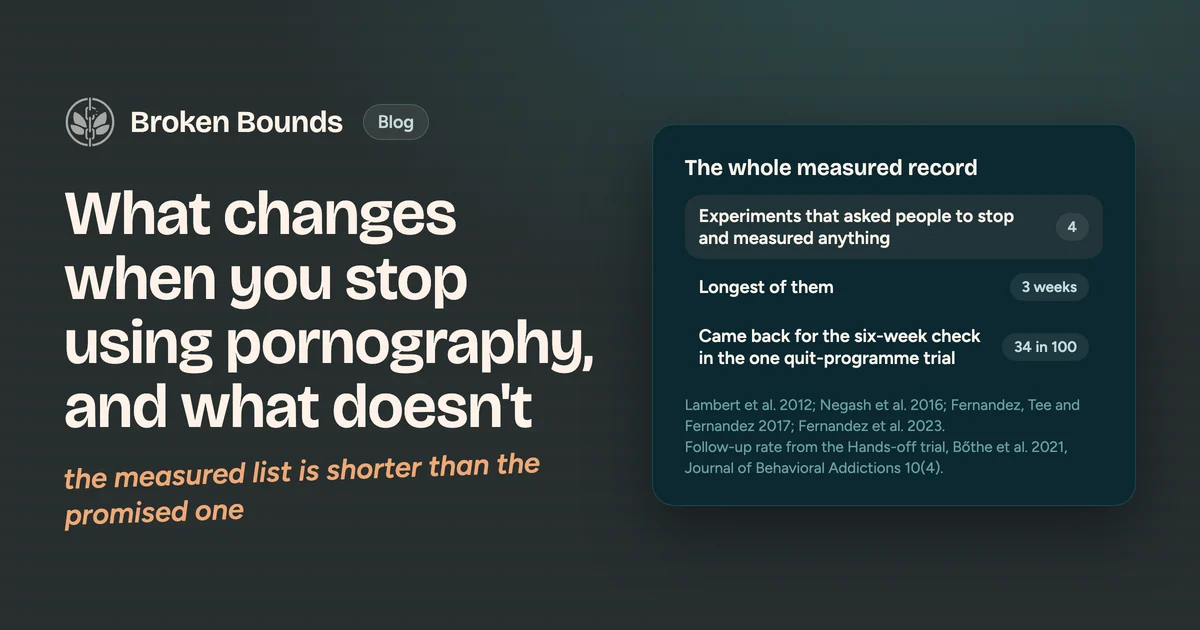
In the whole research literature, four studies have asked people to stop using pornography and then measured something. The authors of the newest one say so themselves. Before their own trial, they write, "three studies have experimentally manipulated pornography abstinence" (Fernandez et al., 2023, Archives of Sexual Behavior). Those three looked at commitment to a partner, at patience for later rewards, and at how compulsive people judged their own use to be.
| Study | What people were asked to do | What it measured | What happened |
|---|---|---|---|
| Lambert et al., 2012 | Stop for a few weeks | Commitment to a romantic partner | Commitment was higher after stopping |
| Negash et al., 2016 | Stop for three weeks, or give up a favourite food instead | Choosing a smaller reward now over a bigger one later | The group that stopped using pornography chose fewer of the smaller, sooner rewards |
| Fernandez, Tee and Fernandez, 2017 | Stop for a few weeks | Whether a questionnaire score matches real difficulty stopping | Effort to stop, and failures at it, tracked the score |
| Fernandez et al., 2023 | Stop for 7 days | Craving, mood, withdrawal-type symptoms | No difference from the group that carried on |
Put into everyday life, those results look like this. After a few weeks without pornography, people felt more committed to the person they loved, and they were better at waiting for something bigger instead of grabbing the quick reward. And when stopping was hard for someone, their questionnaire score showed it, so if you find it hard, that struggle is real and it is not a flaw in you. Anyone who gives you a 90-day timeline with a week-by-week table is telling you about their own months or their customers' months, not about a measurement.
The trial that followed a real quit programme
The closest thing to a test of quitting is the Hands-off trial, built by Beáta Bőthe and her colleagues and approved by Eötvös Loránd University in Budapest. Half of the people who signed up got a six-week online programme about risk situations, cravings, the thoughts that argue for use, and planning for a slip. The other half waited (Bőthe et al., 2021, Journal of Behavioral Addictions).
Among the people who came back at six weeks, the programme group felt less craving and less stuck, and they trusted themselves more to get through a trigger. The group that waited did not move. In daily life, that is the difference between a trigger arriving and you thinking "I can't do this" and thinking "this will pass".
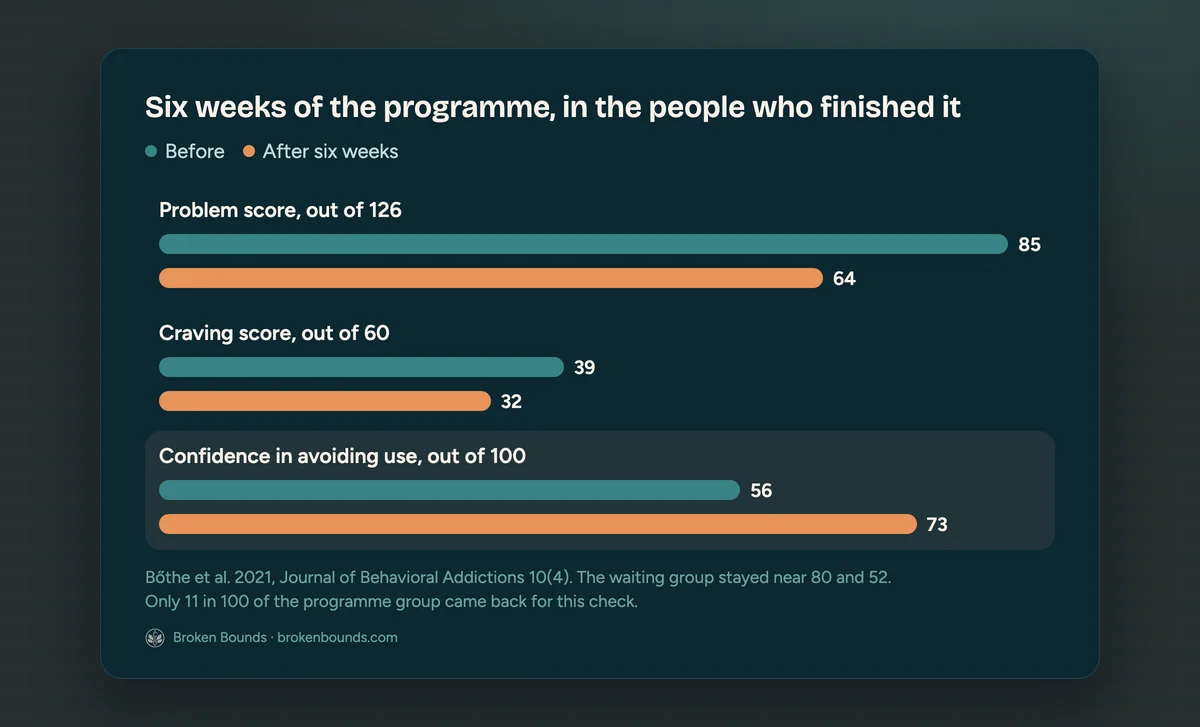
One more number matters for you. Only 34 people in 100 came back for the six-week check. Most of the people who signed up had dropped away by then, so the most useful thing you can do in your first weeks is keep showing up, especially on the days it feels pointless.
The first week is about craving, not a flu
The 2023 trial is the one that surprised me. Regular users were split in two. One group was asked to stop for seven days and the other carried on as usual, and everyone filled in a survey every night.
Nothing separated the two groups. Not craving, not low mood, not a single withdrawal-type symptom. So if you are afraid of a physical withdrawal, a kind of flu you have to sit through, that is not what the first week looks like. About half of the people asked to stop got through all seven days without using, which tells you something about week one on its own.
There was one exception, and the authors only call it a lead to follow up. Among people who scored high for problem use and used every day or more, craving was higher in the group that stopped. If that is you, expect week one to be about craving, and nothing like a flu.
What the first weeks do bring is craving. For a while after you stop, your brain stays especially sensitive to triggers, so the pull can feel strong at first. It gets weaker as the weeks pass, and every trigger you let go by teaches your brain that nothing has to happen.
What people report in their first months
The journals people keep while they quit tell the same story. Researchers at Nottingham Trent University read the abstinence journals kept by men on a forum and sorted what the writers reported (Fernandez, Kuss and Griffiths, 2021, Archives of Sexual Behavior). The most common reported changes were better mood, more energy, mental clarity, focus, confidence, motivation and productivity, each of them attributed to abstinence by the person writing.
The same journals hold the part that gets left off the lists. Some of these men reported the opposite of a boost in desire, a stretch of flat or absent desire they call the flatline, and some found it frightening.
So expect either one, and know that both are part of healing. If you hit a flat stretch, nothing is broken. Your brain's reward system is resetting, and the ability to enjoy ordinary things, and real intimacy, comes back.
Hormones, erections and your brain
These are the three questions I get asked most. Here are the answers.
Hormones. Your testosterone normalises once the use stops, and that helps your sleep, your libido, your focus and your energy. Watch how your energy and mood change over the first months, and if you want a number, a blood test through your doctor gives you one.
Erections. Many men struggle with erections because of pornography. It is common, and in my view it is one of the clearest reasons to stop. Repeated use dulls how strongly you respond to anything that isn't on a screen. Once the use stops, your response to real intimacy comes back and the problem heals. If you're in this spot, you're far from alone, and it is not a sign that something is permanently broken. See a doctor as well, so they can rule out anything medical, and tell them about your pornography use so they see the whole picture.
Healing your brain. Your brain heals. Every time you used pornography, your brain strengthened the pathways that crave it, partly through a protein called DeltaFosB that builds up in the brain's reward centre, and it dulled the pleasure you get from everyday things. When you stop, DeltaFosB fades over the following weeks, ordinary joys feel rewarding again, and the part of your brain that handles self-control gets stronger, so saying no gets easier. The old pathways weaken but are not erased, which is why an urge can still show up months in. The Hands-off trial shows the same healing from the outside: in six weeks of work on risk situations, cravings and thoughts, craving went down and confidence went up. In daily life that means the thing that changes is how you answer a trigger. You practise a new response until it becomes the one that comes first, and you can notice it happening long before any scan could.
A psychologist or a doctor is the right next step when the use comes with serious distress, with depression or anxiety, or with anything medical. If you're ever thinking about harming yourself, call your local emergency number or a crisis line now.
The change I would actually look for
Here's my view, and the course teaches the same thing. The change to watch for is not a day count. It's how much pull you feel.
Take someone on day three who notices a trigger coming, names what it is asking for, and lets it pass. He is in a better place than someone on day 300 who is holding the line by force and has never looked at why the habit was there. If you feel less pull and you have no streak yet, that is improvement, and it is the kind that lasts.
It went like that for me. After a while I stopped counting how long it had been since my last relapse. I had completely given up, and I didn't know what else I could do to make things better. I decided to give it to God and leave behind the things I'm unable to control. I had been carrying the belief that I was the one who needed to control every single movement in my world. When I put that weight down, the habit started to lift. I felt less need to focus on it, and no significant pull toward it. It's a paradox. I gave up, and that changed my mindset so much that from that point on I never did it again.
The day count has a cost as well. A preregistered survey of men who use abstinence forums found that what followed a perceived relapse was shame, worthlessness and sadness (Prause and Binnie, 2023, Sexualities). The same men described the forums themselves as openly cruel, with many reporting misogynist posts and bullying. A counter that resets to zero turns an ordinary Tuesday into a verdict on you. That is a system working against you, and you can drop it.
What I would watch instead, weekly, on paper:
- How strong the pull was at its worst this week, 0 to 10. This is the number the research moved.
- How many triggers you met and did not follow. That is the new habit being built, and it is the only count that goes up.
- Whether one person knows what you're working on. In those journals, support from other people mattered more than any blocker.
- What the habit was being asked to do for you, in one sentence a week. Rest, company, something to feel, a way out of a feeling.
Four lines, a minute a week. After a month you'll have your own record, which beats anyone's timeline.
Common questions
How long until it gets easier? It does not arrive on a date. The first weeks are when your brain is most sensitive to triggers, and the pull eases gradually after that. In the six-week trial the measured changes showed up in six weeks of weekly work, and the thing that moved most was confidence, not comfort. Expect weeks that feel finished and then a wave on an ordinary afternoon, which is a known event rather than a sign that nothing has changed.
Will my concentration and sleep improve? Yes. As your testosterone normalises and your brain's reward system settles, focus and sleep get better, and many people notice it in the first months. Working on your sleep helps from the other side, because a tired brain makes every urge louder.
Do I need to give up masturbation too? The studies differ, and the 7-day trial let people masturbate without pornography. In those journals, some men found a sexual outlet helped them stay away and others found it pulled them back. This is one to test on yourself for two weeks rather than take as a rule.
Is the amount I use the thing to fix? It's not about using too much. The amount tells you very little, and the trial that moved people's use did it by working on risk situations, cravings and thinking, not by setting a quota.
Where do I start? With the gap, not the habit. The free 100-day Broken Bounds course goes at the reasons in the order I found them, one short video and one action a day, with a display name instead of your real one. If you want the practical version of the first week, read how to stop using pornography after willpower has failed, and if you're weighing up programmes, the price comparison is here.
I read, approve and sign every post here. How this blog is written.