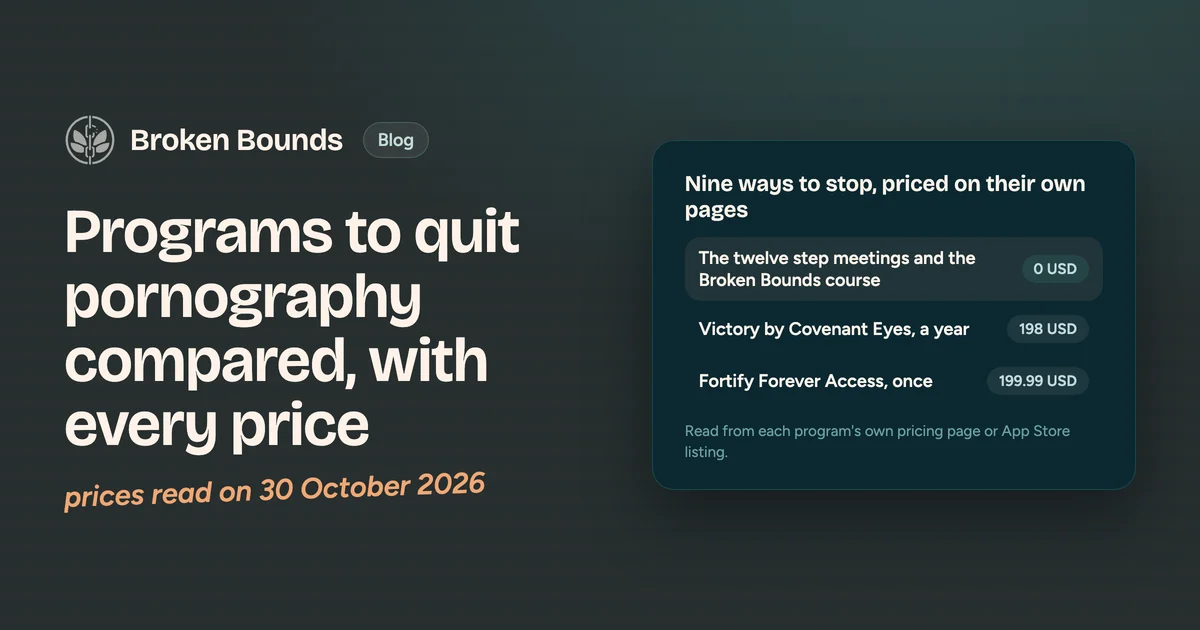
Here's the short version. The programs that come up when you search for help cost anywhere from nothing to 199.99 USD, and the twelve step fellowships ask for no money at all. The only published trial of an online program for this problem found that it helped the people who stayed in it, while 89.4% of them dropped out before the end (Bőthe et al., 2021). So the useful question isn't which program is best. It's which one you'll still be using six weeks from now.
Below is every price I could verify, read off each program's own pricing page or its App Store listing on 30 October 2026.
What each program costs
| Program | Free option | What you pay | Price read from |
|---|---|---|---|
| Broken Bounds | the whole 100 day course, worksheets and community | 49 USD for one 55 minute coaching session, up to 50% off with commitment points | its own coaching page |
| Fortify | Basic plan, 0 USD a month | 12 USD a month or 120 USD a year on the site. 12.00 USD monthly, 89.99 USD a year or 199.99 USD for Forever Access in the App Store. Teens 13 to 17 free and students 6.95 USD a month, both after a short essay | joinfortify.com/pricing and the App Store listing |
| Brainbuddy | free to download | "Brainbuddy Full Access" purchases from 2.99 to 99.99 USD, with several at 12.99 USD, plus three courses at 7.99 USD each. The listing doesn't say which price buys which length | App Store listing |
| QUITPRN | free to download | 4.99 USD a month, 14.99 USD a year, 24.99 USD for lifetime access | App Store listing |
| Relay | 7 day free trial | 149 USD a year | joinrelay.app |
| Victory by Covenant Eyes | 7 day free trial | 18 USD a month or 198 USD a year | covenanteyes.com/victory |
| NoFap forum | the forum itself | nothing for the forum | forum.nofap.com |
| NoFap Groups | none | 20 USD a month for weekly drop in calls, 40 USD a month for an accountability group of up to 35, 120 USD a month for a group of up to 12. The page shows these as reduced from 25, 50 and 150 USD | nofap.com/groups |
| SA, SAA and SLAA | every meeting | no dues and no fees | sa.org, saa-recovery.org |
| A therapist | none | set by the provider and not published anywhere I could check | n/a |
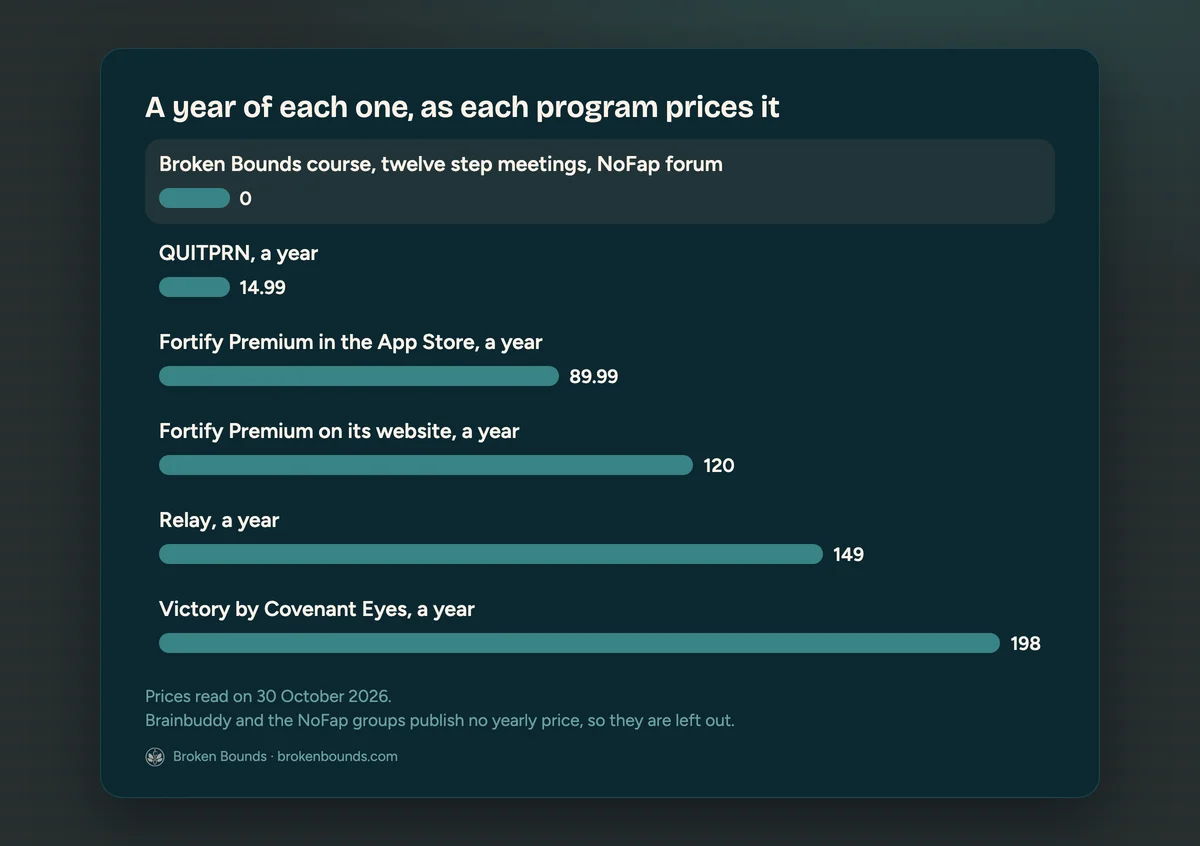
Fortify charges two different yearly prices
A year of Fortify Premium costs 120 USD if you sign up on its website and 89.99 USD if you buy it as an annual subscription inside the iPhone app. The same listing sells Forever Access for 199.99 USD, which the website doesn't offer at all. Nobody is hiding anything here, and the two pages simply don't agree, so check both before you pay. The teen and student prices need a short essay about why you should be chosen, which the website states on the same page.
How I compared them
Here's the method. Every claim above comes from the program's own material, which keeps me from guessing about anyone else's product.
- Prices and plans come from each program's pricing page or its App Store listing, opened on 30 October 2026.
- Where a page says nothing, the table says so rather than filling the gap.
- Features come from the same pages, not from reviews or app store roundups.
- I built Broken Bounds, so read its row and its section below as the author describing his own work.
- Prices change. Before each update of this post I open every page again.
What each one actually does
The tracker and lesson apps
Fortify, Brainbuddy and QUITPRN are phone apps you use alone. Fortify's free tier gives you one educational journey, 30 coaching messages a month, five meditations and one ally. Premium opens 17 journeys, unlimited messages and 37 meditations, by its own pricing table. Brainbuddy's listing sells courses on self control, anxiety and confidence separately, at 7.99 USD each. All three listings say the app language is English, and none offers Hungarian.
The programs built around a group
Relay puts you in a small group of men and asks for a daily check in. Its own page describes a roadmap that moves from abstinence to boundaries to self care. NoFap sells three sizes of weekly call, from a large drop in session to a group of twelve, and says its free forum has been running since 2011. Both groups are priced as a membership, so you keep paying while you keep attending.
Accountability software
Victory by Covenant Eyes watches what happens on your devices and reports it to a person you choose. That is a different product from a course, and it assumes you've already got someone to be accountable to. It also works on the branches rather than the roots, which is why my own course puts blockers and screen rules in the last module, on day 91, after three months of other work. Set up a filter on day one and you'll find out how creative your own mind can be.
The twelve step fellowships
Sexaholics Anonymous, Sex Addicts Anonymous and Sex and Love Addicts Anonymous run meetings worldwide with no dues or fees, funded by members' own contributions. I have real respect for what the fellowships have done for people, and the About page says why they weren't the answer for me. Read each fellowship's own definition of sobriety before you walk in, because they differ. SA's, for example, is stricter than most people expect, and it is written out on its own site.
A therapist
A psychologist is the right next step when the use comes with serious distress, with depression or anxiety, or with anything medical, and no app replaces that. Nobody publishes a single price because sessions are priced per provider. If you're ever thinking about harming yourself, call your local emergency number or a crisis line now.
Broken Bounds, which is mine
The 100 day course is free, all of it, including the worksheets and the community. Each day is one short video and one concrete action, about ten minutes, at your own pace. You need a display name and an avatar, never your real name or a photo. Accounts are for 16 and over, the community and coaching for 18 and over. The one paid thing is a private 55 minute video session with me for 49 USD, and commitment points earned in the course take up to 50% off that.
Does any of this have evidence behind it?
Yes, and I stand behind my own course. People can and do stop, and the research is growing. A 2024 review in Archives of Sexual Behavior gathered 28 studies of treatments for this problem, four of them randomized trials (Roza et al., 2024).
The clearest example is the Hands off trial, run by researchers at ELTE in Budapest with the Swiss institute ISGF. They put 264 people into a six week online self help program or a waiting list. The people who finished reported much lower problematic use than the control group, along with less craving and more confidence in avoiding it (Bőthe et al., 2021). An online program, followed through, made a measurable difference.
My view is that each technique in the Broken Bounds course works on its own, and I put them together because they strengthen each other. That's why the course is built the way it is, one small action a day for 100 days. In the trial, the people who stayed with it were the ones who changed, and the same goes here. Start, and keep going.
What I'd look at before paying
Price is the easiest thing to compare and the least useful. These are the questions I'd ask instead.
- Does it work on the roots or the branches? A blocker, a counter and a cold shower all buy you time. They don't tell you what the habit was doing for you, and that's the part that decides whether it comes back. My view is that you're not short on willpower, you're short on something the habit was supplying.
- Will you still be in it in six weeks? That's the number the research keeps producing. A cheap program you quit is more expensive than a free one you finish.
- Is there a person in it? An accountability partner you speak to every week is worth more than any dashboard. If a program's group is its main feature, ask how often it meets and how many people are in the room.
- What does it count? Most of these apps count days. Counting days alone will mislead you. Let me give you an example, the one I use in the day 13 lesson. Let's say someone holds two weeks, trips, holds one week, trips, then trips again after five days, and the app shows a line going down. What the app can't see is the illness, the heartbreak or the unusually hard week behind those numbers. The skills he picked up in the first two weeks didn't disappear, so measure the pull as well as the days, and the streak will follow later.
- Where did you buy it? The Fortify gap above is 30 USD a year for the same thing. Check the website and the store.
- Can you cancel it today? A monthly membership you forget about is the most common way to pay for recovery without doing any.
- Does it ask for your real name? Shame keeps most people from asking for help at all, so anonymity isn't a luxury feature.
Frequently asked questions
Is a free program as good as a paid one?
On the evidence available, nothing says paying more works better. No study in the 2024 review compared a paid app with a free one, and the trial with the best result used a free research tool. What paying can buy you is a commitment you feel, and some people do need that. If that's you, a fellowship meeting asks for your presence every week, which is a harder commitment than a card payment.
Should I start with a blocker?
Start with one and you've changed your phone, not your week. Blockers belong in the toolkit, and the course teaches them on day 91, after the habits that replace what the use was doing for you. Filters are worth setting up, with the passcode held by somebody else.
Can I do any of this without giving my name?
The fellowships are anonymous by design and ask for a first name at most. The apps need an account, so check what each one wants before you sign up. The Broken Bounds course asks for a display name and an avatar, never your real name or a photo.
Are any of these available in a language other than English?
Not the paid apps. Fortify, Brainbuddy and QUITPRN all list English as their only language. The fellowships are the exception, because they meet in the local language wherever a group exists, and the SA and SAA meeting finders are the place to look.
Is a twelve step group the same as seeing a therapist?
No. A fellowship is a free peer group that follows a programme of steps, and a psychologist is a clinician who can diagnose and treat what sits underneath the behaviour, including depression and anxiety. People do both.
I already paid for a program and it didn't work. What now?
That's the most common story I hear, and it says more about the design of these programs than about you. It's not about using too much. Before you buy the next one, write down what the last one asked you to do every day, and what it never asked about. Most of them never asked what was missing from your week.
I read, approve and sign every post here. How this blog is written.