Whether you tell your partner is your decision, and nobody online can make it for you. What I can give you is what hiding it is costing you right now, what happens on the other side of the conversation, and the words for the three situations people are actually in.
Start with the one thing most pages get wrong. This conversation is not a confession you need absolved. It is you taking responsibility out loud, in front of the person it affects.
Should you tell your partner at all?
My answer is yes, if you are in a committed relationship and the use is secret. Not because secrecy is a crime, but because the secret is doing work in your head. You manage it. You remember what you deleted. You get a small jolt when their hand reaches for your phone. That management is a tax you pay every day, and it is one of the things keeping the habit alive.
There is a situation where the answer changes. If your partner has ever used information about you to control, punish or threaten you, do not hand them something new to use. Tell a professional first, or someone who is safely outside the relationship, and get help deciding what is safe to say. Openness assumes you are safe.
What hiding it is costing you
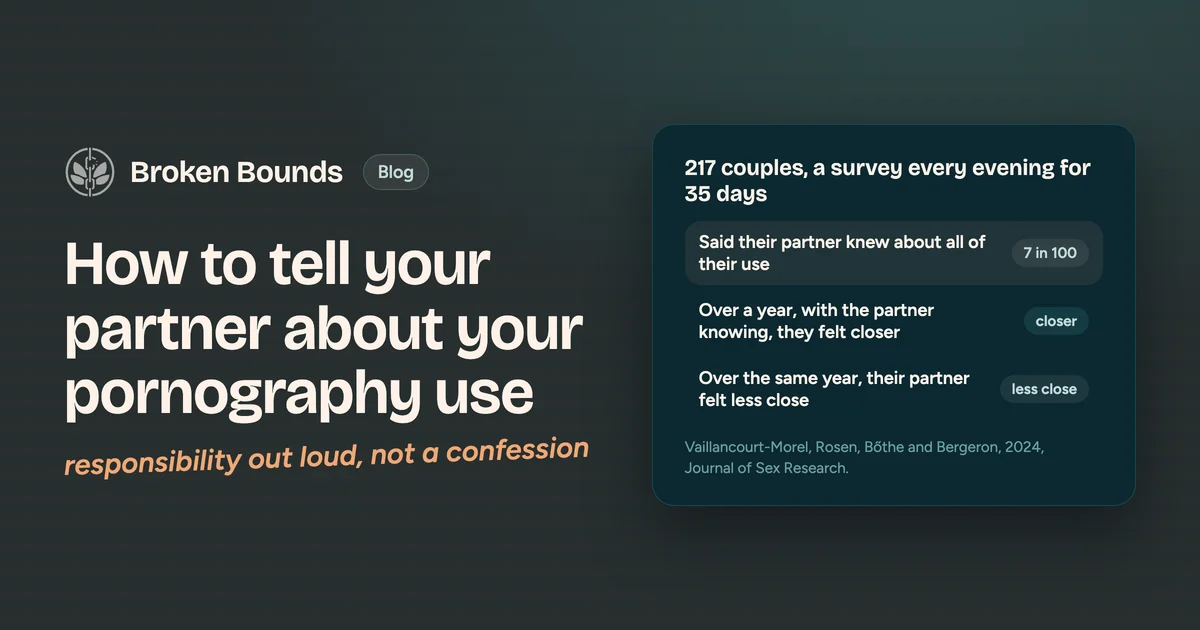
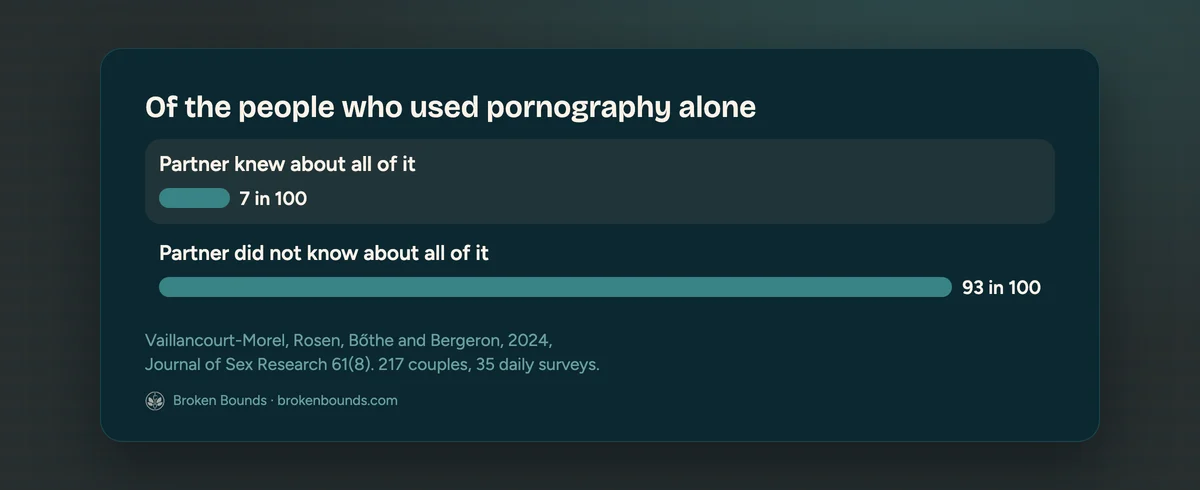
Four researchers followed 217 couples for a year (Vaillancourt-Morel, Rosen, Bőthe and Bergeron, 2024, Journal of Sex Research). For 35 days each person filled in a short survey every evening, saying whether they had used pornography that day and whether their partner knew. Almost nobody tells. Among the people who used pornography alone during those weeks, only 7 in 100 said their partner knew about all of it.
The research group published a plain summary of the whole study as well (Couples and Sexual Health Research Laboratory, 2024). Three of its findings matter for your Tuesday evening.
- On the days someone used pornography and their partner did not know, that person reported feeling less satisfied with the relationship and less close to their partner. The partner's day was unchanged. The cost of hiding landed on the person hiding.
- Over the year, people whose use was known reported feeling closer to their partner than they had at the start.
- Over that same year, their partners reported feeling less close.
Read the last two together, because together they answer "will this fix things". Telling takes the weight off you, and it can leave your partner carrying something they were not carrying before. That is the trade. You tell because you want to stop living two lives, not because the telling is a gift to them.
So plan for their side of it. They may be hurt for weeks. They may ask questions in a week's time that they did not think of on the night. Answering those calmly, again and again, is what turns the conversation into trust rather than a single bad evening.
The three situations, and what to say
Almost everybody who asks this question is in one of three places. Find yours, because the job of the first conversation is different in each one.
| Your situation | What the first conversation is for |
|---|---|
| They do not know, and the use is not running your life | Ending the secret before they find it themselves |
| They do not know, and you have tried to stop and failed | Asking for room to do the work, with a step already started |
| They already found out | Confirming the truth and answering, without negotiating the size of it |
Your partner does not know, and your use is not running your life
You are not in crisis. You use pornography, you would rather not, and you do not want it to be a secret. Keep it short and own it. Something close to this works.
"There is something I have been keeping to myself and I do not want to any more. I use pornography. I am working on stopping, and I did not want you to find it out from my phone."
Then stop talking and let them react. You have said the whole thing. Everything after this is their questions, answered truthfully, at their pace.
Your partner does not know, and you cannot stop
This is the harder one, and the thing to say out loud is that you have already tried. If the use has carried on through real attempts to stop and it is damaging things you care about, that pattern is what the World Health Organization lists as compulsive sexual behaviour disorder (ICD-11, code 6C72). Nobody diagnoses themselves from a blog, and you do not need a label to open your mouth.
Saying "I will stop" to a person who has watched you try before is a promise with no weight behind it. Saying what you are doing about it has weight.
"I need to tell you something I have been carrying on my own. I use pornography, I have tried to stop on my own and I have not managed it. I have started a programme and I am telling you because I do not want to do this alone any more. I am not asking you to fix it."
Name the concrete thing you have already started, such as a course, a counsellor or a weekly call with one other person. One started step is worth more than any promise.
Your partner has already found out
Here the first conversation is not yours to steer. They have had a shock, and the question underneath everything they ask is whether you were lying to them. So answer the actual question, fully, and do not negotiate the size of it.
"You were not wrong about what you found. I am not going to argue about how much or how often. I should have told you myself, and I did not. Ask me anything and I will answer."
Then expect to be asked again next week. Discovery of something hidden is closer to a breach of trust than to an argument about pornography, and trust comes back through repetition, not through one good explanation.
If they ask to check your phone
This comes up fast, and it catches people out. A partner who has just heard this often wants something they can see, so they ask for your passcode, a filter on your phone, or your screen-time report every Sunday.
Say yes to transparency and no to being policed, and know the difference. Opening your phone when they ask, or putting a blocker on it, is fine and it can calm a frightened person down in week one. Handing them the job of watching you is not fine. It makes them your supervisor, it gives them a new thing to be anxious about every evening, and it tells both of you that the problem is access.
Blockers are worth having. In the course they come near the end, with screen-time limits and device-free zones, as support around the work rather than the work itself. Nothing on a phone addresses what the habit was doing for you, which is why people get through a monitored month and relapse in the first unmonitored hour. If a filter helps, set it up together, name it as a stabiliser for the next few weeks, and keep your weekly check-in with someone who is not your partner.
Say it with guilt, and leave the shame out
This is the part that decides how the conversation goes, and it is worth getting right before you open your mouth.
Guilt is the feeling that you have shifted away from the person you are. What you did is not who you are, and you want to get back. That feeling moves you, and it belongs in this conversation. It sounds like "I did this, it is mine to deal with, here is what I am doing."
Shame is different. Shame fuses you with the act and tells you that you are what you did. In a conversation it turns into something your partner can feel. It sounds like "I am disgusting, I do not deserve you", and it quietly asks them to argue you out of it. Now they are comforting you about the thing that hurt them. That is how these conversations go wrong, and it is what the forum threads describe when people say it backfired.
You need no shame. You need enough guilt to want to change, and then tools.
How to prepare, in one evening
A conversation like this goes better with a little preparation and worse with a script.
- Write down, for yourself, the one sentence you want them to walk away with. Usually it is "I was hiding this, I am dealing with it, and I am telling you myself."
- Decide what you will do about questions you do not want to answer. "I will answer that, give me a minute" is a real answer. Lying to a direct question costs you everything you came for.
- Pick the time. Not late at night, not before they leave for work, not in a car. In person, or on a call if you are apart. Never by text or message.
- Decide in advance that you are not asking them to be your accountability partner. That job goes to someone else, and mixing the two puts your partner in charge of policing you, which is poison for both of you.
- Have the next step already started, so the sentence "here is what I am doing" is true.
Point 4 is the one people skip. Your partner can know everything and still not be the person you text at 11pm when an urge hits. In the Broken Bounds course that role goes to someone outside the relationship, by agreement, with a set time each week, because the help you need then is from a person who is not also the one you hurt.
What this conversation is really for
I have watched people treat disclosure as the finish line. It is the opposite. It is the moment the habit loses its hiding place.
The course puts this in a plain order. First you tell one compassionate friend who will support you. Later, when you are stronger, you tell the person it is hardest to tell, someone whose opinion really matters to you, and you accept whatever comes next. Shame is created by avoiding responsibility, so taking responsibility to someone who matters is what takes shame apart. In my own case I remember sitting on a beach, unable to say the word pornography out loud, heart pounding, getting it out at the last minute before we had to go. What came back was compassion well beyond what I expected. Every time since, when something in me did not want a person to know, I told them anyway, and I felt free afterwards.
For many people the partner is both of those people at once, which is why this conversation is so heavy and why it changes so much.
A psychologist, a doctor or a couples counsellor is the right next step when the use comes with serious distress, with depression or anxiety, or when the relationship is in trouble beyond what the two of you can carry. If you are ever thinking about harming yourself, call your local emergency number or a crisis line now.
The week after
The conversation is one evening. What you do in the following week is what your partner will actually read.
- Answer the follow-up questions the same way you answered the first ones. Calmly, without shrinking the facts.
- Do the thing you said you had started. Day 1 of a course they can see beats a promise they cannot.
- Get your own support in place, outside the relationship, this week.
- Leave their feelings alone. They do not have to be over it, and asking them to be is asking them to look after you again.
- Expect a wave of urges. A hard conversation is a trigger like any other, and a relapse is information, not a verdict.
Common questions
Do I have to tell them every detail? No, and do not let the conversation turn into an inventory. Tell the truth about what you have been doing and that you hid it. If they ask a specific question, answer it. Volunteering details you would not be asked for is usually shame looking for punishment.
What if they ask me to promise it will never happen again? Promise the work, not the outcome. "I cannot promise you a feeling will never come. I can promise you the work. I am doing the course, I have someone I talk to every week, and you will hear it from me and not from my phone."
Should I tell a partner I have just started seeing? You owe a new partner the truth about who you are, not a file on your past. If the use is secret and ongoing, that is a thing they should hear from you. If it is behind you, it is your story to tell when you want to.
What if they want me to stop and I am not sure I can? Then say exactly that, and say what you are doing about it. In my view the amount was never the thing to work on. It's not about using too much. The habit is filling a gap, and that is what you go after, which is what the free 100-day course does, one short video and one action a day, with a display name instead of your real name.
Will telling them make the urges easier? It takes away the energy you were spending on cover. What changes when you stop is a slower thing than that, and if you want the practical first week, start here.
I read, approve and sign every post here. How this blog is written.