Start with the reason you reach for it, not the amount you watch. Blocking apps, cold showers and day counters all work on the behaviour, and the behaviour is the part that was never really the problem. In a 2025 study of 890 Hungarian adults, using pornography to cope with feelings predicted problematic use far more strongly than using it for pleasure or curiosity did. Frequent use on its own was not inherently problematic (Csányi et al., 2025, International Journal of Sexual Health).
So the useful question is not "how do I stop watching?" It is "what is this doing for me, and what do I do instead at the exact moment I reach for it?" That is the plan below. Find the job the habit is doing, take away its monopoly on that job, and give yourself something to do in the ninety seconds when the urge arrives.
Why willpower and blockers keep running out
Willpower is a bet that you will be stronger than the urge every single time, forever. You will not be, and neither will anyone else. I thought I could be strong and disciplined enough to do this alone, without anyone noticing, and that did not work even after four years of trying. The same goes for distraction. Going for a run when an urge hits does delay it, and a delay is worth having, but it never answers what the urge was asking for. I believe that is why so many people stack up blockers and streaks for years without anything changing underneath.
Look at what the ranking advice actually contains. The guides at the top of search results for this question mostly repeat the same four moves. Notice your triggers, install a filter, replace the habit with exercise, find accountability. Some add that you should cut down gradually, to every other day. None of them starts from the finding that separates a problem from a habit, which is the motive rather than the amount.
Researchers have mapped eight reasons people use pornography. They are sexual pleasure, sexual curiosity, emotional distraction, stress reduction, fantasy, boredom avoidance, lack of sexual satisfaction and self-exploration (Csányi et al., 2025, using the Pornography Use Motivations Scale). Grouped together, the pleasure-driven reasons predicted problematic use only weakly. The escape-driven ones, stress reduction and getting away from a feeling, predicted it strongly. This research looked at people at one point in time, so it shows a pattern rather than proving which one causes the other, and the pattern is steady. The people in trouble are mostly the ones using pornography as a way out of something.
This is where my own view comes from, and it is the opposite of how most programs are built. It's not about using too much. You might be using a great deal, and that is still not the thing to work on. What you have too little of is rest, connection, purpose, a way to come down from a day. Pornography fills a real gap with something that works for twenty minutes. Fill the gap properly and it loses most of its pull.
Find the job the habit is doing for you
For the next five days, do not try to quit. Just write down four things each time you use, or each time you nearly do:
- Time and place. Bed at 11pm, desk at 3pm, bathroom after an argument.
- The feeling in the ten minutes before. Bored, wired, lonely, rejected, exhausted, numb, angry.
- What you had just done. Scrolling, working late, a conversation that went badly, nothing at all.
- What you wanted it to give you. Sleep, a break, comfort, excitement, a way to stop thinking.
Five days is usually enough to see the shape of it. Most people find two or three recurring jobs, not twenty, such as falling asleep and coming down from a day at work. "I use it to fall asleep" and "I use it when I feel useless after work" are different problems with different answers, and until you can name yours you are guessing.
Write it as one sentence. When I feel X, at time Y, I use pornography to get Z. That sentence is the thing you are actually working on.
What has evidence behind it
Two kinds of treatment have been tested properly enough to be worth your time.
| Approach | What it targets | What the trial measured |
|---|---|---|
| Acceptance and commitment therapy, 12 sessions | the urge's authority over you, and acting on your values instead | viewing down 93% against 21% in the waiting group, still 86% below baseline at three months, with 28 adult men (Crosby and Twohig, 2016) |
| Hands-off, a six-module web program | risk situations, habits, cravings, automatic thoughts | problematic use and frequency both substantially lower after six weeks, with 264 adults, called preliminary by the authors (Bőthe et al., 2021) |
| Blocking software | access | not tested as a treatment in either trial |
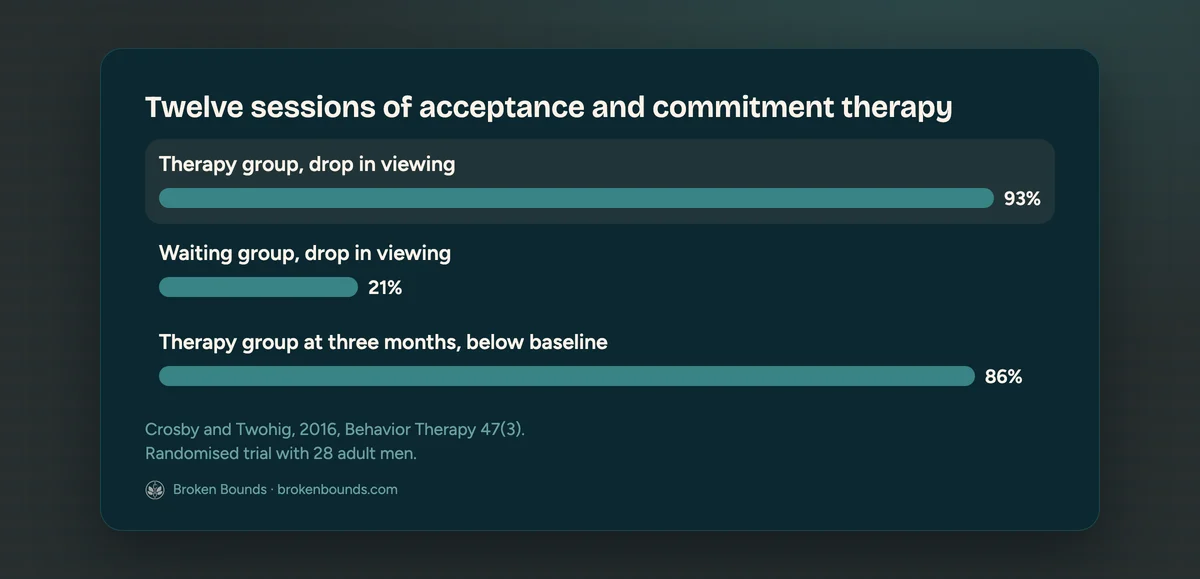
Acceptance and commitment therapy does not teach you to fight urges. It teaches you to let the urge be present without letting it decide what you do next, and to act on what you actually value instead.
The Hands-off program is worth reading as a syllabus, whatever you think of the effect sizes, which its own authors call preliminary after a lot of people dropped out before the follow-up. Its six weekly modules covered motivation to reflect on your use, identifying risk situations, changing habits and adding activities you enjoy, managing cravings, challenging automatic negative thoughts, and relapse prevention.
Notice what is not in either of them. No gradual reduction schedule, no filter software, and no counting of clean days as the measure of progress. The tested approaches work on the motive, the thoughts and the situation, which is exactly what the popular advice skips.
What the next five years cost, in numbers
Before the plan, the thing worth looking at squarely, because the first step below asks you to picture five years.
It is ordinary, and heaviest among people your age. In Barna's national surveys of July and August 2015, 57% of adults aged 18 to 24 said they seek it out at least once or twice a month, against 43% of 25 to 30 year olds, 41% of Generation X and 17% of baby boomers (Barna, 2016). The samples were 813 people aged 13 to 24, with a margin of error of 3.4 points, and 1,188 adults aged 25 and over, 2.8 points. Whatever you have told yourself about being unusual, you are not.
It travels with depression. 1,864 young adults were asked about depression and anxiety, then asked a year later how often they viewed pornography. Those with both depression and anxiety symptoms at the start were 2.72 times as likely to be viewing every day as people with neither (Singareddy et al., 2024, Archives of Sexual Behavior 54(2)). The authors are careful that this cannot say which way the arrow points. Both directions matter to you.
It shows up in relationships. A review that pooled 50 studies, covering more than 50,000 people in 10 countries, found pornography use tied to being less happy with your relationship and your sex life. It showed up in one-off surveys, in studies that followed people over time, and in experiments, and the effect was clear for men (Wright et al., 2017, Human Communication Research 43(3)).
Divorce lawyers see it in the room. At a 2002 meeting of the American Academy of Matrimonial Lawyers, the attorneys surveyed said 56% of their divorce cases (Manning, 2005) involved one party with an obsessive interest in pornographic websites. Jill Manning reported that figure in testimony to a United States Senate subcommittee, and published her review of this research the following year. It is lawyers describing their caseloads rather than a study of marriages, and she said so herself, so read it as what the people who sit through divorces notice.
The money, as far as anyone counts it. The security company Webroot published the figures that get quoted everywhere, about 3,076 US dollars a second spent on pornography online, and 16.9 billion dollars a year in lost productivity in the United States (page dated 22 March 2016). The per-second number is what you get if you take an estimate of the industry's yearly income, about 97 billion, and divide it by the seconds in a year. Nobody counts that income properly, and published guesses for it run from about 10 billion up to that 97. The productivity number comes from Nielsen research of February 2010 finding 28% of people (Webroot, 2016) had visited such sites from a work computer, an average visit of 13 minutes, and about an hour and 38 minutes a month, priced at the US Bureau of Labor Statistics hourly earnings of March 2012, which works out at roughly 49 dollars per employee per month. Webroot's page states no source for the 16.9 billion itself, and other vendors' estimates of the same thing run several times higher. Treat both as the scale of the thing, not as measurements.
None of that is here to make you feel worse, and none of it decides anything about you. It is the background against which the first question below deserves a straight answer.
Your first week, in the order that works
The order matters more than the list does, and the last item is the one most people start with.
One. Answer two questions, in writing. What will your life, your relationships and your work look like in five years if this carries on exactly as it is? And what will they look like if this is gone? Write five things under each. Keep the page somewhere you will see it. Everything else gets easier once you have a reason that is yours and not borrowed, and most people have never actually written theirs down.
Two. Track instead of quitting. The five-day notebook above. Nothing changes while the loop is still running outside your awareness, which is the whole point of making it conscious first.
Three. Stop punishing yourself, and take responsibility instead. These are not the same move. Being hard on yourself produces nothing but unkindness; responsibility produces action, which is the only thing that ever feels like justice served. A short exercise I give on day three. Split a page into what you can control and what you cannot, put at least five things on each side, then tear off the second column and throw it away.
Four. One small habit, tracked daily. Not a new life. One thing, in the morning, before your phone. Make your bed, drink a glass of water, open the window. Tick it on a calendar every night. It sounds too small to matter against something this size, and it is exactly how you get back the sense that you do what you decide to do.
Five. Unfollow everything that aims at you. Not a filter. The accounts in your own feed that post the one thing you cannot look at. If an account has posted it once, the person behind it will post it again. This takes an evening and it removes more of your triggers than any software will.
Six. When the urge comes, name the feeling in words. Not "I'm struggling." The specific thing, out loud. "I'm lonely, it's 9pm, and I want to disappear for twenty minutes." Ten seconds, no notebook needed. Putting a feeling into words quietens the alarm system in your brain, the part that sets the feeling off (Lieberman et al., 2007, Psychological Science), which is also why the journalling works. Then step outside, or put cold water on your face, or message one person who knows. Expect the urge to stay a while anyway. That is normal, and it passes without you doing anything about it. Be honest about what these do. They buy you the ninety seconds in which you can still decide. They do not quit for you.
Last, and only last, the blockers. Removing private browsing, turning on SafeSearch and setting up the filters is day ninety-one of the hundred in my course. I started there myself, years ago, and it was the wrong end, because filters cut branches rather than roots and a craving brain eventually finds its way around them. Worth doing, once the rest of this is in place, as the last thing you put in your own way instead of the plan.
When a lapse happens, the next hour decides more than the lapse does. Guilt and shame get used as the same word here, and they are not. Guilt has responsibility inside it. I did that, it was my choice, and it does not match who I want to be. It points at the behaviour, it is temporary, and it is what makes you want something different tomorrow morning. You need enough of it to move. Shame does something else entirely. It rewrites who you think you are, tells you that you are the kind of person who does this, and then freezes you where you stand. That is the one that sends people back within a day, and you need none of it.
How to tell whether you are getting better
Almost everyone measures this one way, by how many days have passed since the last time. I did too. The trouble shows up the moment the numbers go the wrong way. Two weeks, then one week, then five days, and it reads like a slide back into it.
Put the circumstances next to the number before you believe that. If those two weeks were ordinary and the five days held a bereavement, an illness or a week of unusual pressure, then they are not the same five days. Think of levels in a game. You get to level three, you meet something at level fifty, and it beats you twice. You did not lose the three levels, and the skills that got you there are still yours. What beat you was simply bigger than what you had trained for.
That reading contains a trap, because it can become a supply of excuses. Two questions separate them. Am I acknowledging this to honour it, or to sit in it? And would what I am telling myself sound encouraging or merely permissive if a friend said it in my position? Self-empathy arrives alongside responsibility. Self-pity substitutes for it.
So measure both, the number and what the week contained. And count the thing nobody counts, which is the pull itself. If pornography has less grip on you than it did a month ago and you have no streak yet, that is improvement, and it is the improvement the streak is eventually made of.
Understanding what progress is inside your head helps here, because it is not deletion. Your brain does not fill the old channel back in. It digs a second one beside it and learns to send you down that instead, leaving the original where it always was, dry and perfectly shaped.
That explains two experiences that convince people they have achieved nothing. A craving arrives on day forty from a clear sky, because the newer lesson fades a little faster than the older one. Or a hotel room, or your old bedroom at your parents' house, undoes a month overnight, because the new route was established in your kitchen and your own evenings and has never been walked where you are standing. Practise it deliberately in several places, tired and bored included.
Is this a recognised problem?
Partly, and it helps to know exactly how. The World Health Organization lists compulsive sexual behaviour disorder in ICD-11 as an impulse control disorder, code 6C72. "Pornography addiction" is not itself a formal diagnosis, and researchers still disagree about how to classify it. The ICD-11 description is narrower than most people expect (Kraus et al., 2018, World Psychiatry 17(1)):
- a persistent failure to control intense, repetitive sexual impulses;
- over an extended period, such as six months or more;
- numerous unsuccessful attempts to stop;
- real distress, or damage to your work, family or relationships.
Distress that comes only from disapproving of yourself morally is explicitly not enough for the diagnosis.
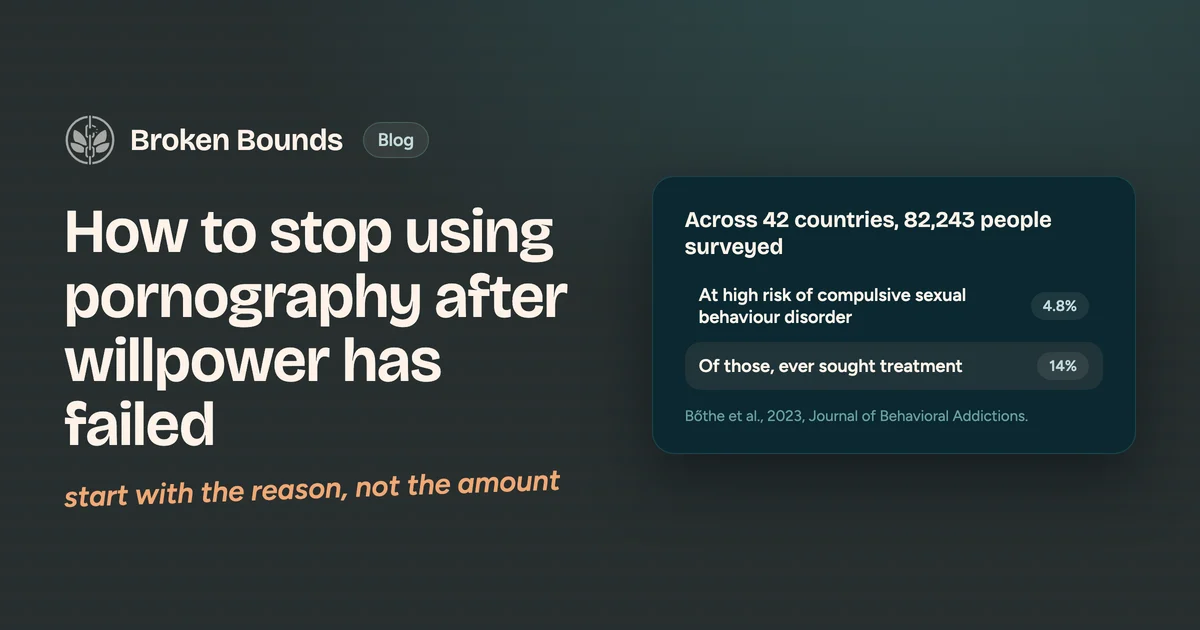
How common is it? In a survey of 82,243 people across 42 countries, 4.8% were at high risk of compulsive sexual behaviour disorder. Only 14% of those who met the criteria had ever sought treatment (Bőthe et al., 2023, Journal of Behavioral Addictions). Whatever label fits you, you can start working on the motive today without waiting for a diagnosis.
One thing to be clear about. If this comes with depression or anxiety, if the distress is serious, or if anything medical is involved, a doctor or psychologist is the right next step, and this article is not a substitute for one. If you are thinking about harming yourself, call your local emergency number or a crisis line now.
Where my course fits
I built Broken Bounds because I spent five years trying to quit on willpower and promises. I remember reading "admit you are powerless" and thinking, fine, but what do I actually do on a Tuesday morning, alone and tempted? The course is a hundred days, one short video and one concrete action a day, about ten minutes each. It covers the same ground as this article, in order, from the why to becoming conscious of your own loops, replacing the patterns, mindfulness, your body, relationships, and finally building a life you do not need to escape. The course is free, all hundred days of it, and anonymous. Private coaching with me is the only thing that costs money.
Frequently asked questions
How long does it take?
There is no straight number to give you. The trials above measured six weeks and twelve sessions and found large drops in use, but they measured use, not whether the gap was filled. Expect the moment-to-moment part to get easier within weeks, and the underlying part to take months.
Should I cut down gradually instead of stopping?
Some guides suggest halving it first. Given the evidence that the motive rather than the amount is what makes use problematic, I would not build a plan around a reduction schedule. If pornography is the way you handle a feeling, using it half as often leaves that intact.
Do blockers work?
As something that slows you down, yes, and that is genuinely useful on a bad night. As a solution, no. You have a second device, and you know it.
Does a long streak mean I am fixed?
It means you have not used in a while, which is good news and not the same thing. Your brain kept the old path, so a long streak is a new route winning, not an old one erased. The question is whether the reasons you used are still waiting for you.
What if I do not know whether I have a problem at all?
Use the ICD-11 description above rather than a quiz. Have you tried repeatedly to stop over months and not managed it, and is it costing you something real? If the answer is no, and you are only unhappy with yourself for doing it, that is worth untangling too, but it is a different question.
Can I do this without telling anyone?
Yes, and most people start that way. My course asks for a display name and an avatar, never your real name or photo.
That is the whole method. Stop fighting the behaviour, and start answering what it was for. How I research, write and check these posts is set out in my editorial policy.