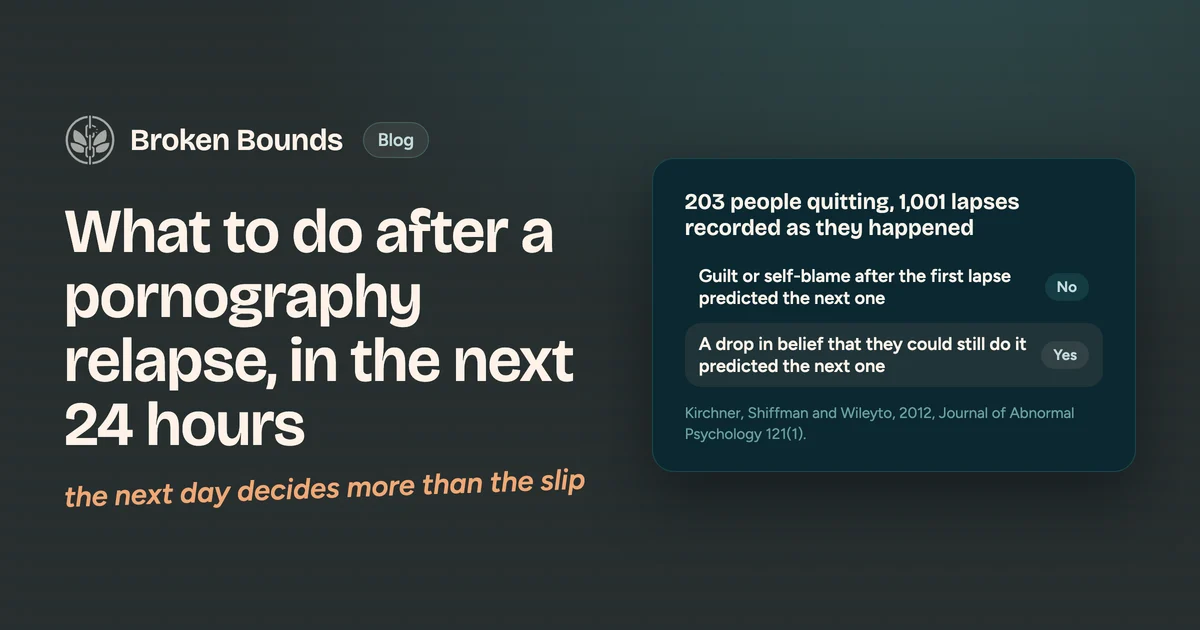
Write down what happened, before you do anything else. The one study that followed real lapses one at a time found that what sped up the slide into the next lapse was not the slip and not even the guilt. It was the drop in a person's belief that they could still do this. Taking responsibility, as in "I did that, it was my choice", was mildly protective (Kirchner et al., 2012, Journal of Abnormal Psychology, 203 people quitting smoking, reporting on 1,001 separate lapses in near real time).
It followed people quitting smoking, and it is the closest thing anyone has to a minute-by-minute record of what happens after a slip. For you, tonight, it means the slip does not decide your next week. What you tell yourself about it does. The twenty minutes are over and you cannot do anything about them. The next 24 hours are still yours.
A relapse is information with a short shelf life
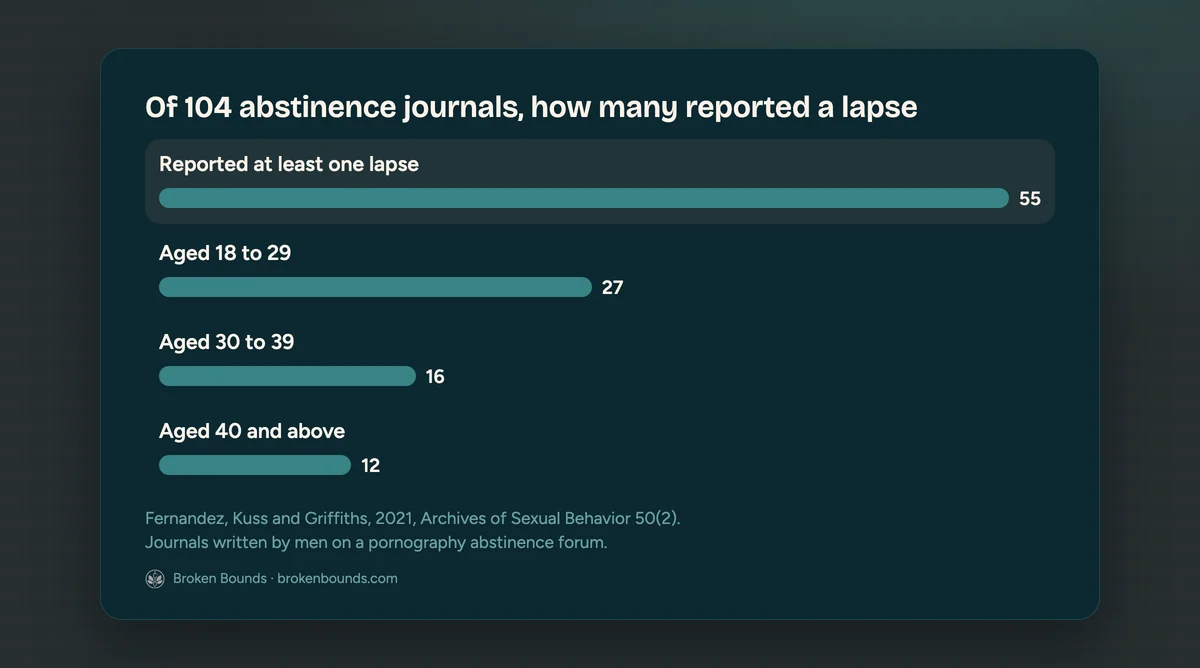
The most detailed look at what people do after a lapse comes from 104 abstinence journals written by men on a pornography abstinence forum (Fernandez, Kuss and Griffiths, 2021, Archives of Sexual Behavior). More than half, 55 of 104, reported at least one lapse, and they were not evenly spread across the ages. The researchers describe relapse as an "insidious process" that caught people off guard and left them distressed straight afterwards.
It arrived in two ways. Sometimes a craving got so strong that it came with its own argument, which members quoted almost word for word. "This could be last time." "Just today, and from tomorrow I stop again.". Other times there was no strong craving at all and the lapse happened on autopilot, often after a slow drift through material that did not technically count as pornography.
And here is the part no ranking page mentions. Some members wrote in their journals while the craving was still on them, or in the minutes right after a lapse. They used that writing to talk themselves round, and to catch the thinking that had tricked them. The detail fades fast. By tomorrow you will remember that you used, and not what you were feeling at 10:40pm.
The next 24 hours
1. Write four lines, within the hour. Time and place. The feeling in the ten minutes before. What you had just been doing. What you wanted it to give you. That is the whole entry, and it is the only piece of evidence you will ever get about this particular slip.
2. Say one true sentence about it, and stop there. "I did that, it was my choice" is responsibility. "I'm hopeless, I always do this" is a verdict on you as a person, and it is the one that predicts your next week. The difference is not a mood, it is the thing the smoking study measured.
3. Split what you could control from what you could not. Take a sheet of paper and draw a line down the middle. Write five things on each side. Then cut the page, crumple the "could not control" half and throw it away. You can control what is on your phone and when you put it down. You cannot control that an ad existed. People spend weeks punishing themselves for the right-hand column.
4. Tell one person today. In the journal study, social support and accountability were the external resources that mattered most, far more than blocking apps, which members described as useful but easy to get round. One message to someone who already knows is enough.
The first time I told a friend, it was really difficult. I was so embarrassed that I couldn't even finish talking. But after I shared my problem, he told me he felt like crying, because he had a similar problem. It was a relief, even though it all came out in a hurry, and I knew it was a big first step toward asking for help.
If there is nobody yet, the free Broken Bounds course runs on a display name and an avatar, never a real name or photo, which is how most people start.
5. Keep tonight ordinary. No new regime, no 90-day pledge, no app bought at midnight. Go to bed at your normal time and do tomorrow's normal first thing. Big promises made in the hour after a slip are made by the part of you that wants to feel better now, and they are usually gone by Thursday.
6. Fix the one gap your four lines point at. If the entry says 11pm in bed, the fix is where the phone sleeps, not your character. If it says after a conversation that went badly, the fix is having somewhere to put that feeling. One gap, this week.
Shame costs you next week. Guilt does not
Among people seeking help for compulsive pornography use, a tendency towards shame went with more hypersexual behaviour. A tendency towards guilt went with more motivation to change (Gilliland et al., 2011, Sexual Addiction & Compulsivity). So the morning after a slip, the feeling that you are rotten is the one that keeps you stuck, and the feeling that what you did is not who you are is the one that gets you moving.
Guilt and shame are two separate things that feel similar. Guilt is temporary and it is about the behaviour. It says what I did is not who I am. It feels like you stepped away from the person you are, and it makes you want to get back. Shame goes after your identity. It tells you that you are what you did. It makes you hide, which cuts you off from the help you need, and it does not produce change, it produces hopelessness.
You need no shame at all. You need enough guilt to want something different, and then tools. "Don't beat yourself up" is the advice everybody gives and nobody can follow, because it tells you to stop a feeling. Taking responsibility is something you can actually do, and it does the job that self-punishment was pretending to do.
Why it happened, and it is usually one of three things
Your progress does not get deleted by a slip. The old response was never erased in the first place. What quitting builds is a second response alongside it, and the old one stays there, dry and perfectly shaped. That is why the same slip can feel like it wiped out eleven weeks when it wiped out nothing. There are three situations where the old one wins, and they are all documented.
| Which one it was | How you can tell | What it needs |
|---|---|---|
| Time | Weeks were easy, then a quiet day felt like week one, with nothing setting it off | A sentence you say every time you walk away, as a reminder of the work |
| A new place | You were solid at home, then a hotel, a trip or your old bedroom undid it in a night | Practising on purpose in places you have not practised in yet |
| One slip | You used once, and the pull came back louder than your last few weeks | The four lines, and the gap they point at |
Time. You are on day 40, nothing has been hard for two weeks, and then an ordinary Tuesday afternoon feels like day 3. Nothing triggered it. The newer response fades a little faster than the old one, so for a while the old one gets louder. What helps is a reminder tied to the work you did. In a study of people afraid of public speaking, cues kept with them while they practised reduced the return of fear later. The benefit was larger for the people who felt the cue as a reminder of the practice, and smaller for those who found it comforting (Shin and Newman, 2018, Behavior Therapy). So pick one short sentence and say it out loud every single time you walk away from an urge, in the same words. Not a lucky charm. A pointer back to the road you have been building.
A new place. You are solid at home for weeks, then you travel and one hotel room undoes it. Your new response was learned in your room, and it was never installed in that hotel. A review of the research found that practising the new response in several different settings clearly reduced the chance of the old one returning (Bustamante et al., 2024, Learning and Behavior). So practise it in the car, on the sofa, at your parents' house, tired, bored, after a good day and after a terrible one.
One slip. The third one needs no name. Using once strengthens the old route again straight away. It did not erase your progress, and it did re-cut a channel that had gone quiet.
How to tell whether you are actually improving
Say someone manages two weeks, which is their longest yet, then uses again. A week later, again. Five days after that, again. It looks like the gaps are closing and the whole thing is unravelling.
Now ask what else was in those weeks. A breakup, an illness, a stretch of unusually heavy triggers. Think of it as a game you are levelling up in. You cleared the first three levels with the skills you had, then walked into a level 50 enemy, twice. That does not delete the skills and it does not mean your progress stopped.
That reading has a trap in it, and the trap is excuses. Circumstances explain, they do not excuse, and compassion for yourself is not the same as letting yourself off. Three questions tell you which one you are doing. Am I acknowledging my pain to honour it, or to sit in it? Do I want to understand my circumstances, or to justify staying stuck? What would I say to a friend in my shoes, and would it sound strengthening or permissive?
So measure both, the streak and the circumstances. And if you feel less pull towards it than you did a month ago but have no streak to show, I would call that improvement. Someone on day 3 who knows what their habit is for can be closer to free than someone on day 300 who has only been holding their breath.
One thing to be clear about. If this comes with depression or anxiety, if the distress is serious, or if anything medical is involved, a doctor or psychologist is the right next step, and this article is not a substitute for one. If you are thinking about harming yourself, call your local emergency number or a crisis line now.
Common questions after a relapse
Do I have to start over?
You start from where you are, which is not the same place you started last time. The understanding you have gathered about your own triggers does not reset with the counter.
How often do people relapse?
Often enough that the chart above is the normal picture rather than a bad one. Nobody has a reliable overall figure for people trying to stop, and in the one study that counted, most men lapsed at least once.
Should I reset my day counter?
Do what you like with the number. Just do not let it be the verdict. A counter measures how long it has been. That is useful, and it is not the same as whether the reasons you used are still waiting for you.
What if I relapse every day?
Then the gap between one slip and the next is not the problem to solve, and the four lines matter more than ever, because a daily pattern shows its shape within a week. If repeated attempts over months have gone nowhere and it is costing you things that matter, that is the point to bring in a professional rather than another method.
Does a blocker help after a relapse?
As one more barrier on a bad night, yes. Members in the journal study kept using them while saying plainly that they could get round them, and valued them as a reminder in a weak moment. As the answer to why you used, no. If you want the full picture of what the programs and apps cost and what each one actually does, I compared them in programs to quit pornography.
A relapse is the clearest information you will get about what the habit is still doing for you, and it is only readable for about an hour. Use it. How I research, write and check these posts is set out in my editorial policy.