The distress is real, and the World Health Organization has a diagnosis for it. The diagnosis is not called pornography addiction. The WHO's ICD-11 lists compulsive sexual behaviour disorder, code 6C72, as an impulse control disorder. Pornography is one of the behaviours it can involve, and researchers still argue about whether "addiction" is the right word for any of it (Kraus et al., 2018, World Psychiatry).
So the useful question is not whether the word is allowed. It is whether what's happening to you matches what the diagnosis describes, and what to do about it either way.
What the WHO actually lists
Compulsive sexual behaviour disorder is, in the ICD-11's words, a persistent pattern of failing to control intense, repetitive sexual impulses or urges. It is placed among the impulse control disorders, not among substance use and addictive behaviours. The authors of the WHO working group's paper say why. They don't yet have definitive information on whether the processes involved match those in substance use, gambling and gaming, so they took the conservative position, which may change as research does (Kraus et al., 2018).
That is the whole reason you read "not an addiction" in some places and "an addiction" in others. Both sides are describing the same people. They disagree about the shelf the problem sits on.
Neither of the two big manuals names pornography addiction as a diagnosis. A 2025 Hungarian study says so plainly for ICD-11 and the American DSM-5, and it deliberately avoids the word "addiction" in its own results (Erdős et al., 2025, Journal of Medical Internet Research). So if a doctor uses a name other than "addiction", they are using the official term, not telling you nothing is wrong.
What the description says, in plain words
For a diagnosis, the pattern has to include all of these:
- A lasting failure to control intense, repetitive sexual urges or behaviour.
- It goes on for an extended period, for example six months or more.
- Many unsuccessful attempts to cut back or stop.
- Real distress, or damage to work, family, relationships or other parts of life.
That's the shape of it. The WHO paper adds one more line that matters a lot. Distress that comes only from moral judgment or disapproval of sexual urges doesn't count (Kraus et al., 2018).
What is not in the description
Look at what's missing. There is no number of hours, no number of times a week, and no particular kind of content. The test is loss of control and the harm it causes, not the amount.
The research agrees. In a 2025 Hungarian study, frequent use on its own was not inherently problematic, while using pornography to cope with feelings predicted problems much more strongly (Csányi et al., 2025). In the 42-country survey below, how much people had used in the past year was only weakly to moderately linked to their score (Bőthe et al., 2023).
It's not about using too much. Someone can use a great deal and keep control of their life. Someone else can use rarely and feel unable to stop. The second person is closer to the description.
How common is it?
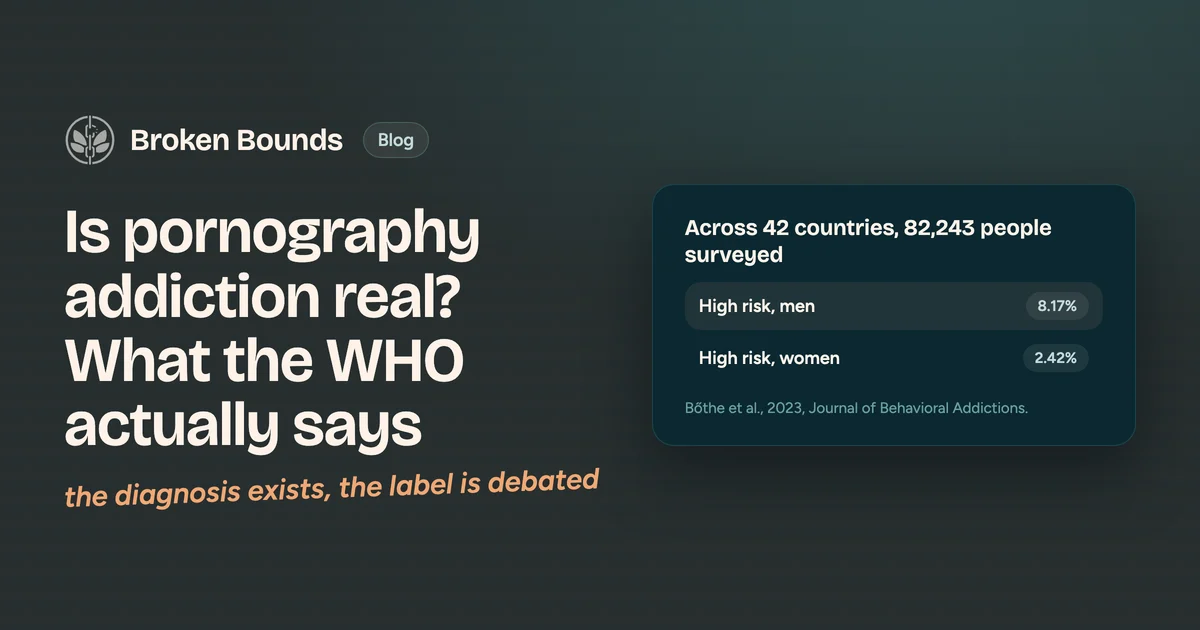
The largest survey so far, the International Sex Survey, asked 82,243 people in 42 countries questions built around the ICD-11 description (Bőthe et al., 2023, Journal of Behavioral Addictions). The chart shows who scored at high risk.
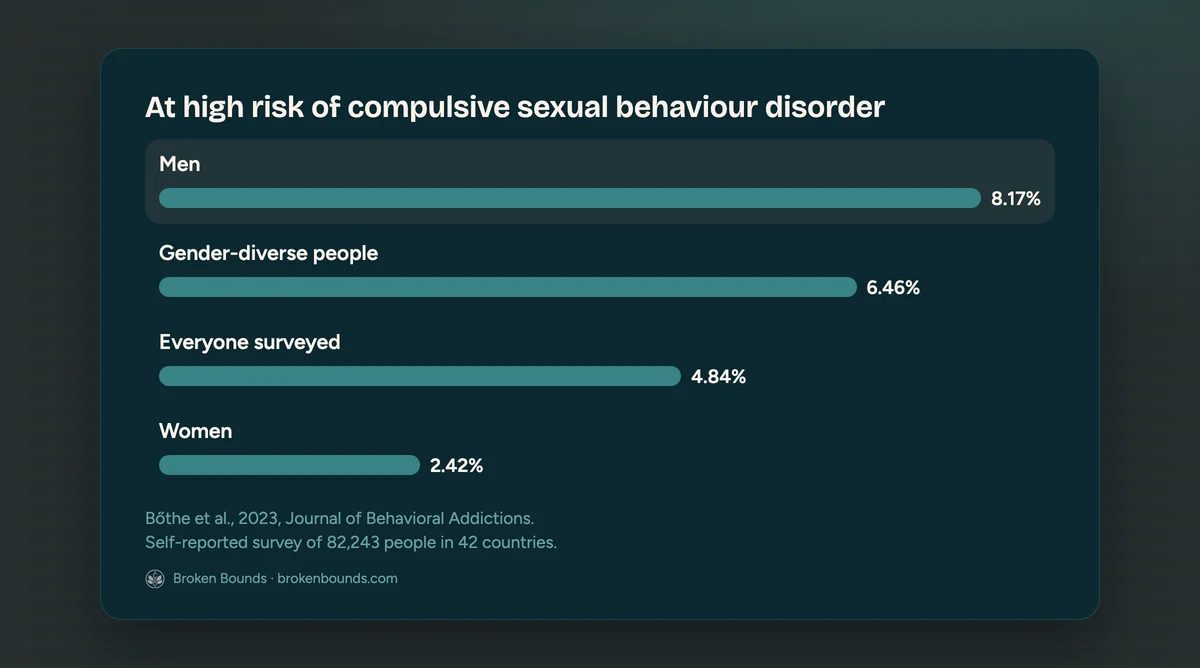
If you're reading this alone and wondering whether you're the only one, you're not: out of a hundred men, about eight scored this high.
Only 13.7% of the high-risk group had ever sought treatment, and many of those who hadn't said they would have felt uncomfortable or embarrassed. If you've never told anyone, you're in the large majority, and telling one person is often the first real step.
A high score isn't a diagnosis. Only a clinician can make one.
Why researchers still disagree
There are two live arguments, and you don't have to settle either to get help.
The first is the shelf. Impulse control disorder, behavioural addiction, or something else. That is a question of filing, not of what happens in you. Every time you reach for pornography, the brain's reward pathways for it get stronger, and once the use stops they weaken, and everyday pleasures start to feel rewarding again.
The second is the role of morality. Some people feel that their use is an addiction mainly because they strongly disapprove of it, not because they've lost control of it. A review of the research on compulsive sexual behaviour and religion describes moral disapproval as shaping how strongly use is linked to calling oneself addicted (Jennings et al., 2021, Journal of Behavioral Addictions). That's exactly why the ICD-11 excludes distress that comes only from moral judgment. If your faith or upbringing makes you feel strongly about this, that feeling is not the problem. The question is still whether you can stop when you want to.
Neither argument says the struggle isn't real. People who can't stop doing something that is hurting them are in a real struggle, whatever it ends up being called.
Does the label matter?
Less than people think. My view, after five years of being stuck and over six years of being free, is that the label is the wrong place to spend your energy. If you read "it's not a real addiction" and feel relieved, you may skip the work. If you read "it is" and feel doomed, you may stop trying. Neither helps.
What helps is looking at what the habit does for you, and I lay out how in how to stop using pornography after willpower has failed. I believe pornography fills a gap, in connection, rest, purpose or a way to come down from the day, and that people don't use too much so much as have too little of something real. Fill the gap and the habit loses its pull. That is also why I don't believe in counting days as the measure of success. A streak says how long you've held out. It says nothing about the reason you reached for it.
Shame gets in the way here. Shame makes you believe you are the problem, that you are what you did, and someone who believes that sees no point in asking for help. Guilt works the other way. It tells you that what you did is not who you are, and that gap is what moves you to change. You need none of the first and a little of the second.
How to tell for yourself
Skip the online quizzes. The scales that researchers built and tested are the ones clinicians use. Ask yourself the questions the description asks:
- Have I tried to cut back or stop, more than once, and failed?
- Has this gone on for months, not days?
- Is it costing me something real, such as sleep, work, money, or closeness with someone?
- Would I want to stop if nobody judged me for it?
If you answered yes to most of them, talk to a professional. My course is one more place to start. If you answered no to the last one, and your distress is mostly about what you think you should feel, that is a different conversation, and an equally valid one to have with someone trained to help.
When to see a professional
A doctor or psychologist is the right next step if this causes serious distress, comes with depression or anxiety, or if anything medical is involved. This article is not a substitute for one. If you're thinking about harming yourself, call your local emergency number or a crisis line now.
Questions people ask
Is pornography addiction in the DSM-5?
No. Neither the DSM-5 nor the ICD-11 lists pornography addiction as a diagnosis (Erdős et al., 2025). The ICD-11 lists compulsive sexual behaviour disorder.
Is it only men?
No. Women were at high risk too, less often than men, but far from never.
Is watching every day a problem?
The diagnosis doesn't count days; it asks about control and harm. I don't believe there is a safe amount, though. The better question is which direction you're heading.
Where does Broken Bounds fit?
I built Broken Bounds because I spent five years trying to quit on willpower and promises. It's not a clinic. The course is free: a hundred days, one short video and one action a day, anonymous, with a display name and an avatar. Private coaching with me is the one paid extra.
That's the whole answer. The label is debated and the struggle is not. How I research, write and check these posts is set out in my editorial policy.